

Leadership development is not a course. It is a coaching cadence.
Most organizations run a workshop and call it leadership development. The behaviors do not change because behaviors require practice, feedback, and repetition, not a single 90-minute session. This article defines what leadership development actually is, walks through the proven process, and shows what measurable results look like when organizations get it right.
Quick answer: what is leadership development?
Leadership development is the sustained process of changing observable leadership behaviors in managers and executives. It differs from a one-time course or workshop because effective development requires a repeated cadence of practice, feedback, and re-measurement. The signal of success is behavioral, specifically, how a manager runs a 1:1, delivers difficult feedback, or responds to pressure, not how they score on an attitude survey. Organizations that build this cadence consistently reduce time-to-performance for new managers and see measurable improvement in team retention and output.
What is leadership development?
Leadership development is the systematic process by which organizations identify and build the observable skills required for effective leadership. It is not a one-time event. It is a comprehensive practice designed to bring managers and executives from where they are today to where the organization needs them to be, measured in behaviors that can be seen and coached.
The key word is observable. Abstract traits like "strategic mindset" or "executive presence" are difficult to coach because they are difficult to define and even harder to measure. Observable behaviors, such as how a manager opens a difficult conversation, whether they acknowledge a direct report's concern before proposing a solution, or how they frame a deadline under pressure, can be practiced, scored, and improved over time.
This distinction separates effective leadership development from traditional approaches. HBR's academic literature focuses on program design. FranklinCovey's catalog focuses on course completion. Neither measures what actually changes in the room when the manager faces a challenging situation. Retorio's approach starts from the behavioral signal and works backward to the coaching cadence that shifts it.
Source: Retorio enterprise deployment studies across 4,609 active managers globally.
Why observable behavior is the measurable unit
Most leadership development frameworks target attitude or knowledge: "understand strategic thinking," "embrace a coaching mindset," "develop executive presence." These are valid goals but unmeasurable outcomes. You cannot coach someone's mindset directly. You can coach how they open a difficult conversation.
Behavioral science research on skill acquisition, including work cited in the Harvard Business Review on the future of leadership development, confirms that lasting capability change requires practice with feedback in a realistic context, not information transfer. Observable behaviors give you both: a concrete behavior to practice and a concrete signal to measure after.
"Traditional programs no longer adequately prepare executives for the challenges they face today and those they will face tomorrow."
Harvard Business Review, The Future of Leadership Development
Observable leadership signals vs abstract traits
Here is the practical translation. Each abstract trait maps to a set of observable behaviors that can be scored, practiced, and coached in a session:

The leadership development process
Understanding what leadership development is sets the direction. The process is how you get there. Below is the five-phase cadence that produces durable behavioral change, the same structure that separates organizations with measurable leadership outcomes from those running workshops that produce satisfaction scores but no behavioral shift.
Identify and baseline
Map the behavioral competencies the organization needs, not abstract traits, but specific observable behaviors. Run a baseline assessment, structured peer observation or AI-assisted behavioral scoring, to understand where each manager sits today. This creates a starting line and a coaching agenda.
Define critical competencies
Not all leadership behaviors carry equal weight for your context. A sales manager needs different observable signals than an engineering director. Identify the three to five behaviors that most directly connect to your business outcomes, whether that is team retention, pipeline conversion, or cross-functional alignment, and build the coaching cadence around those.
Practice in realistic scenarios
This is where most programs fall short. A workshop or an e-learning module informs managers about the behavior but does not change it. Behavioral change requires deliberate practice in a context close enough to the real situation to trigger the same cognitive and emotional responses. AI role play, structured peer coaching, and job-rotation assignments all serve this function when designed around the target behaviors.
Score and provide feedback in the moment
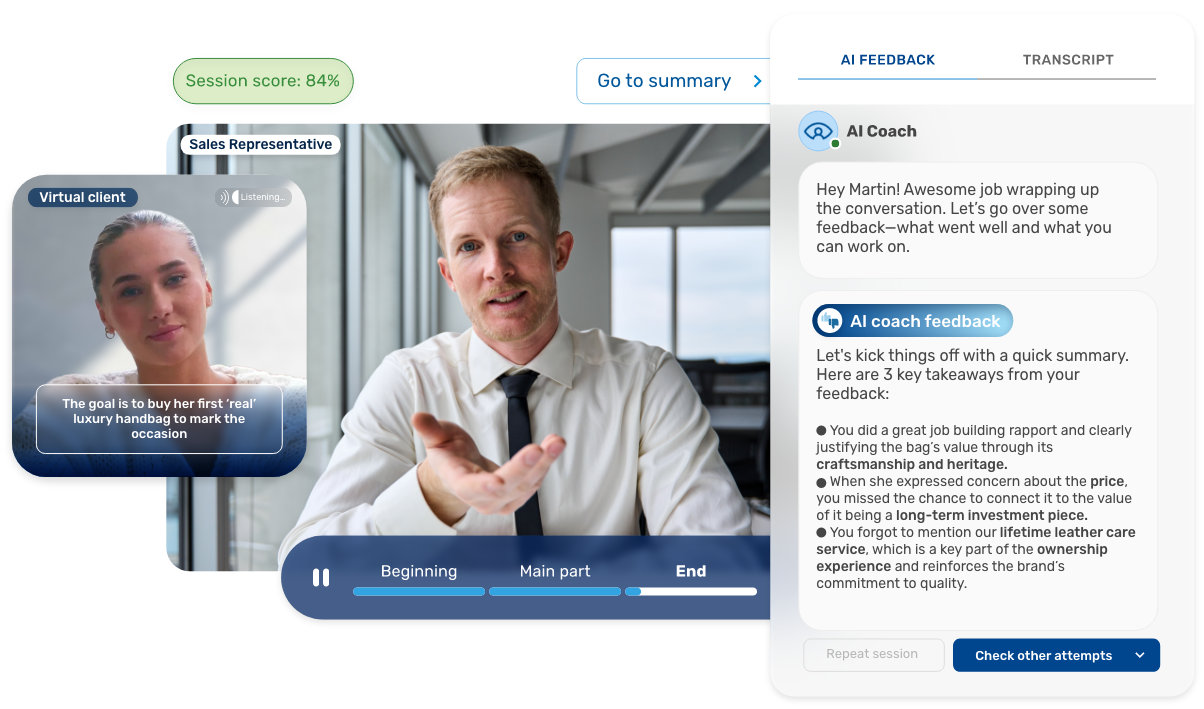
Feedback after the fact is weak. The closer the feedback is to the behavior, the stronger the learning signal. A manager who receives behavioral scoring on a role-play session within seconds can correlate the feedback to exactly what they said and how they said it. Traditional 360-degree reviews, delivered quarterly, arrive too late to anchor specific behavior changes.
Remeasure and close the loop
At week 8 and week 12, re-run the baseline behavioral scoring. If the behavior has shifted, the coaching cadence is working. If not, the scenario needs to be redesigned or the feedback loop needs to be tightened. This closed loop is what converts leadership development from an activity into a capability-building engine.
Benefits of leadership development
When the process is right, behavioral outcomes translate directly to business outcomes. Organizations investing in a sustained coaching cadence see measurable results across three dimensions:
You might also be interested in: what management coaching covers and why it matters.
What leadership development is not
Clarity on what qualifies is easier when you see what does not. Here are the most common approaches that organizations label leadership development but that rarely change behavior:
Leadership development across three phases
Corporate structures require a pipeline of talent at different stages. Effective development addresses three categories with distinct behavioral targets:
The emerging manager
Transitioning from individual contributor to team lead. The behavioral target: how do they delegate without micromanaging? How do they deliver feedback for the first time? The coaching cadence focuses on communication and trust-building behaviors.
The evolving director
Moving from personal success to team success and cross-functional influence. The behavioral target: how do they align competing priorities without authority? How do they coach managers beneath them? The cadence focuses on influence and coaching-down behaviors.
The senior executive
Defining vision and culture. The behavioral target: how do they communicate strategic decisions under uncertainty? How do they handle stakeholder conflict in real time? The cadence focuses on high-stakes communication and psychological safety at scale.
The sustained cadence
Across all three levels, the method is identical: baseline behavioral scoring, scenario practice with immediate feedback, remeasure at week 8 and week 12. What changes is the behavioral target and the scenario context.
Building a leadership development plan
According to research by Gartner on HR leader priorities, 79% of HR leaders report that their peers do not collaborate with HR to identify the behavioral skills required for future leaders. The gap is not awareness; it is execution. Here is how organizations close it.
A working plan has five elements:
Related: how motivation connects to behavioral capability building in teams and what soft skills coaching looks like in practice for managers.

The Retorio approach to leadership development
Retorio's AI Coaching Platform delivers the behavioral coaching cadence described above at enterprise scale. Managers practice in photorealistic AI role-play scenarios designed around their specific leadership challenges, including difficult 1:1 conversations, feedback delivery under pressure, and cross-functional alignment discussions. The platform scores 140+ behavioral signals and returns immediate feedback on what to adjust and how.
This approach is distinct from traditional platforms in one critical way: it closes the loop. The behavioral score at week 0 is compared to the score at week 8 and week 12. When the score moves, the development is working. When it does not, the coaching agenda is adjusted. Retorio is GDPR-compliant, ISO 27001 certified, and hosted with EU data residency, making it a viable deployment for enterprise organizations operating across geographies.
Simon Sinek on what makes leadership effective, from TED. Behavioral clarity starts with understanding why people follow.
See leadership development that changes behavior, not just attitude scores
Retorio's behavioral coaching cadence gives managers practice, feedback, and re-measurement in one platform. Trusted by 80+ enterprise customers globally. ISO 27001 certified. EU data residency.
Start with Retorio📋 Key takeaways
Frequently asked questions
What is leadership development?
Leadership development is the sustained process of building observable leadership behaviors in managers and executives. It differs from a one-time course or workshop: effective development creates a repeated practice-and-feedback cadence that changes how a manager runs a 1:1, delivers difficult feedback, or responds under pressure. The measurable signal is behavioral, not attitudinal.
What are examples of leadership development?
Examples include structured AI role-play sessions where managers practice delivering feedback under pressure, 360-degree behavioral observation by peers and direct reports, spaced scenario practice with a coaching feedback loop, and rotational assignments that expose high-potentials to cross-functional leadership challenges. The common thread is repeated practice with observable outcome measurement, not passive content.
How long does leadership development take?
Observable behavioral shifts require at least 8 to 12 weeks of consistent practice. Enterprise deployments tracked behavioral outcomes and saw measurable shifts in 1:1 quality and feedback clarity at the 8-week mark, with full consolidation at 12 weeks. Leadership development is an ongoing cadence, not a fixed-duration event.
What is the difference between leadership development and management training?
Management training covers process skills such as running a performance review or reading a P&L. Leadership development targets behavioral competencies such as how a person communicates under pressure, builds psychological safety, and shapes team culture over time. Behavioral competencies require a different method: repeated scenario practice with coaching feedback, not a one-day workshop or e-learning module.